
Ramjet vs vanilla, Paper, Leaf and Folia
Five Minecraft 26.3 servers, one machine, the same worlds and the same 50 players. Every number, how we got it, what we got wrong along the way, and what we still have to fix.
Ramjet is a Minecraft Java server written from scratch in C++. We ran it, the official 26.3 server, Paper, Leaf and Folia through the same scripted tests on the same machine, with the same bots, and measured every server from outside the process. Here is everything, including the parts where Ramjet doesn't win and the mistakes we made before the numbers were right.
- per tick with 50 players on one world. Leaf 40, Paper 49, vanilla 71
- 14 ms
- in the same test. The others use 8.2 to 13.4 GB
- 1.1 GB
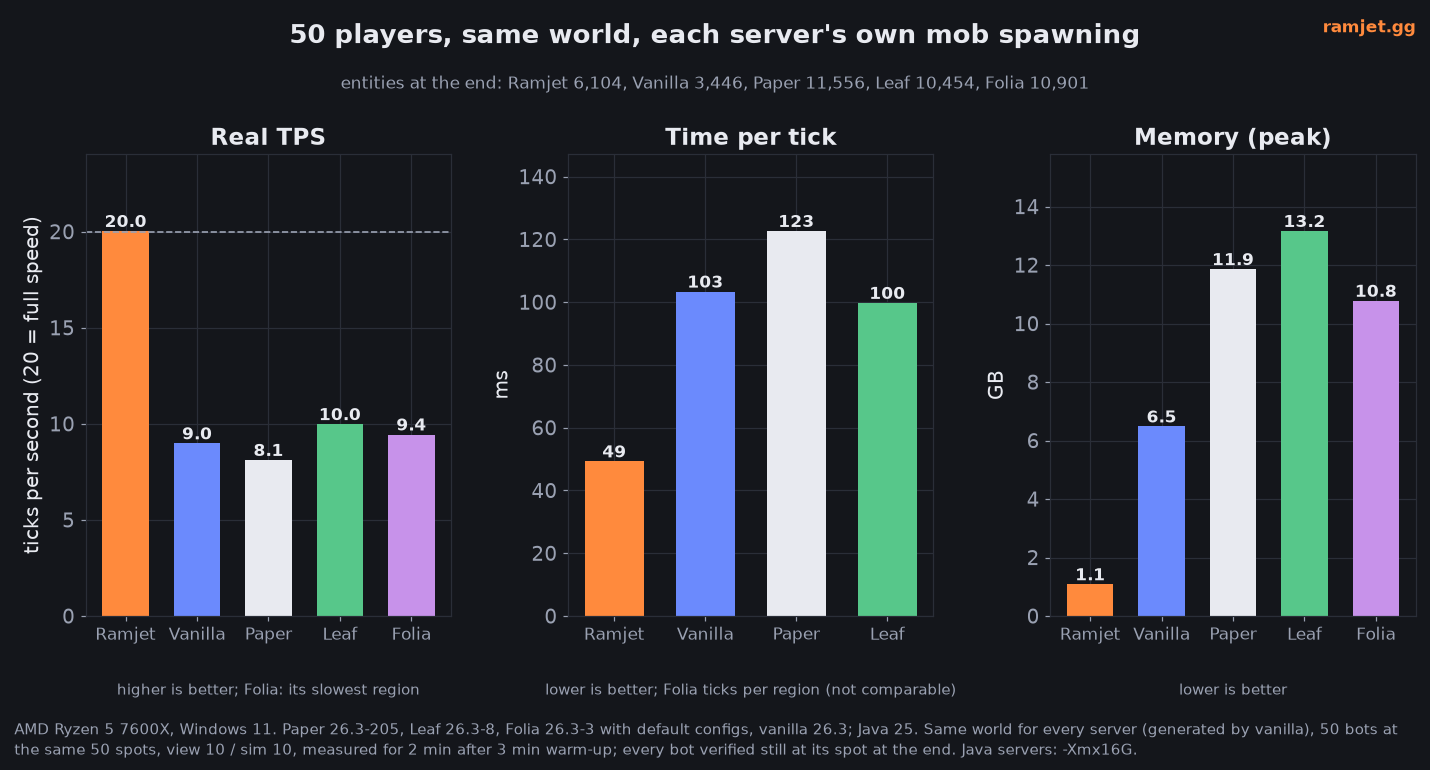
- with real mob spawning. The others drop to 8.1 to 10.0
- 20 TPS
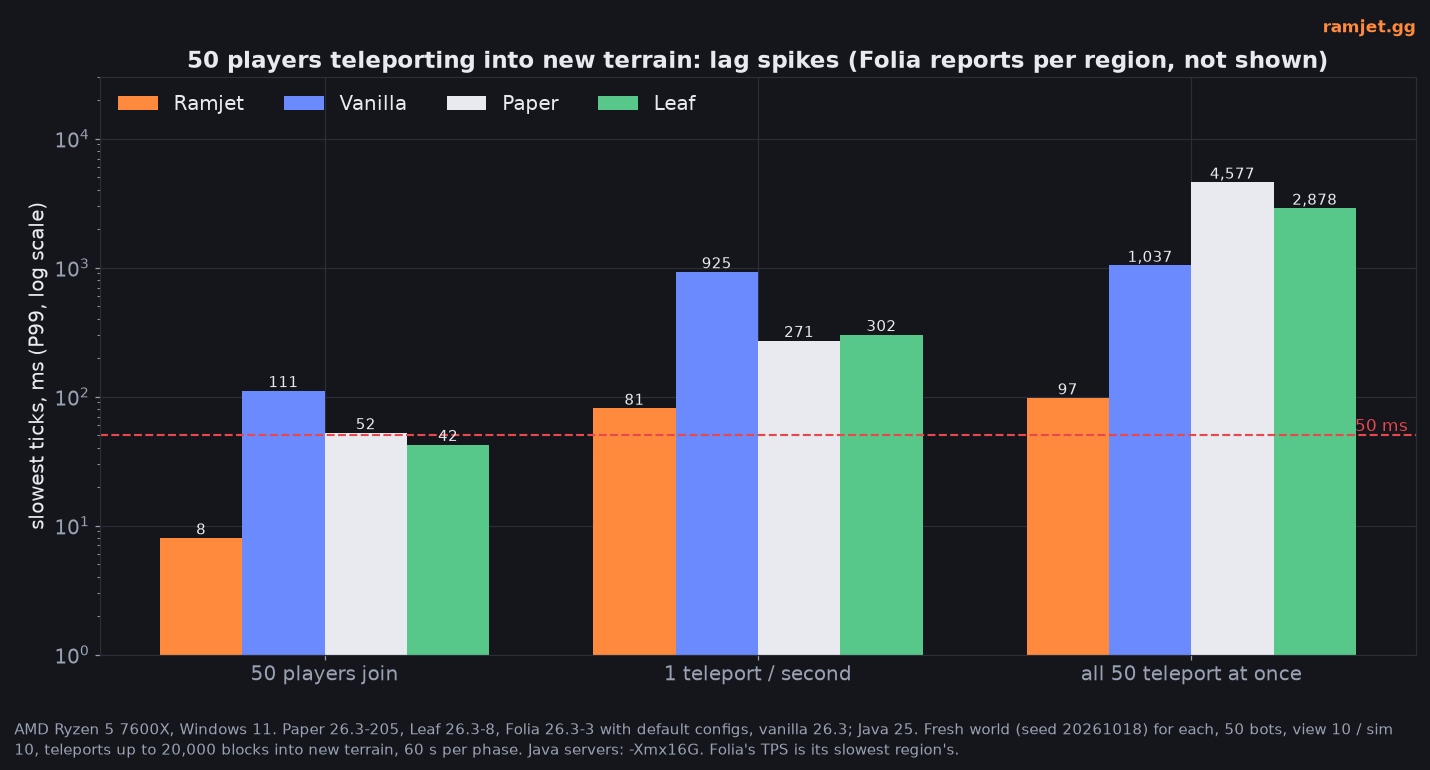
- worst tick when 50 players teleport at once. Paper freezes for 4.6 s
- 97 ms
Fifty players, one world, the same mobs
Fifty players stand in fifty places up to 20,000 blocks apart: about 28,000 generated chunks, with the animals and mobs that live in them. The world was generated by vanilla first, and every server loaded its own copy. Natural mob spawning is off for this test, so every server ticks the same saved animals and mobs and nothing else. The same 50 players were placed at the same 50 spots, given 3 minutes to settle, and measured for 2 minutes. At the end we checked that every player was still at their spot.
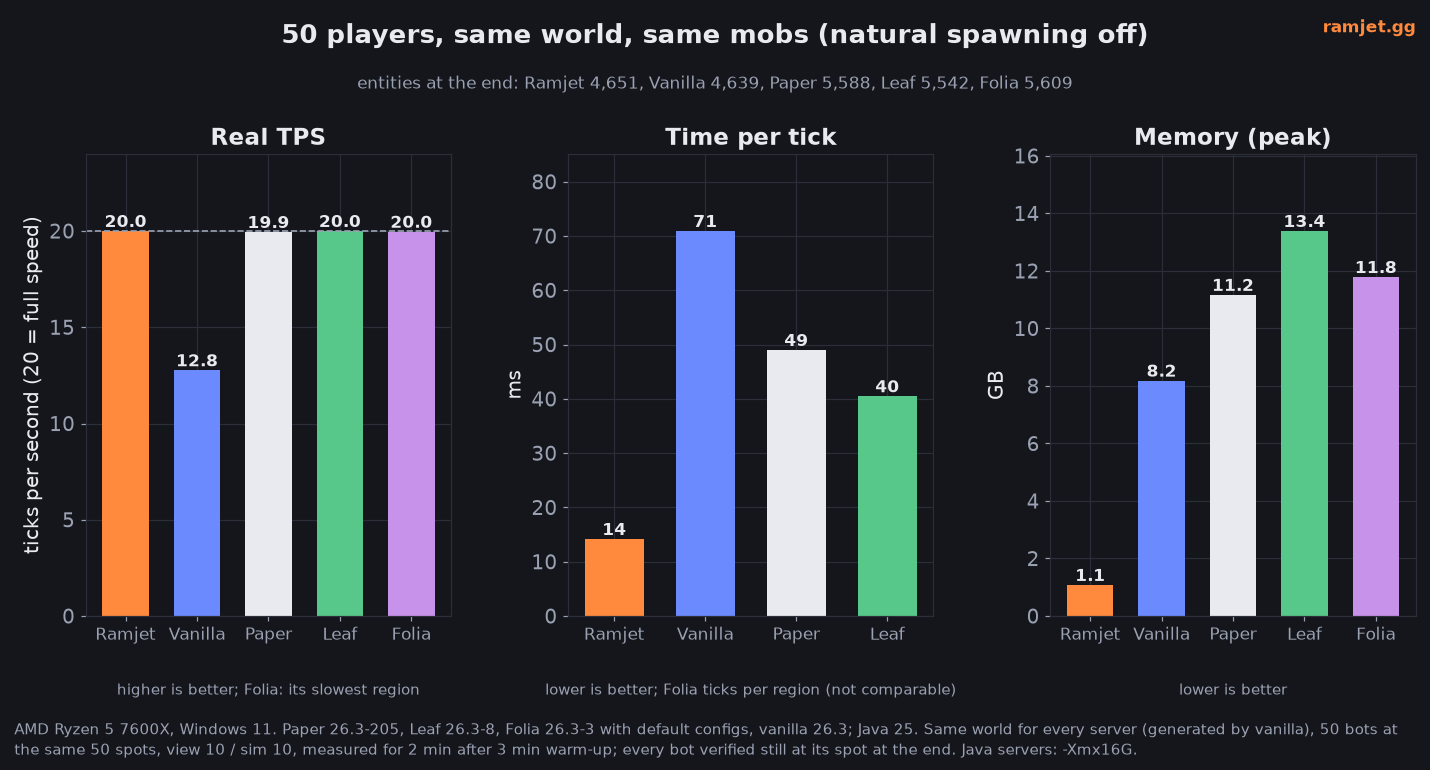
| Same world, same mobs | Ramjet | Vanilla | Paper | Leaf | Folia |
|---|---|---|---|---|---|
| Real TPS | 20.0 | 12.1–13.4 | 19.9–20.0 | 20.0 | 20.0* |
| Time per tick | 14.0–14.4 ms | 67.5–74.3 ms | 47.9–50.1 ms | 40.1–40.9 ms | —* |
| Memory, peak | 1.1 GB | 8.2 GB | 11.2 GB | 13.4 GB | 11.8 GB |
| CPU used | 0.8–0.9 cores | 1.3 cores | 1.1–1.2 cores | 1.1–1.2 cores | 1.0 cores |
* Folia: its slowest region's TPS. Folia has no single time per tick; its busiest regions took 2.3 to 2.4 ms each.
The same test with real mob spawning
Same world, same players, but each server spawns mobs the way it ships. This is what a live server looks like, and the servers no longer do the same work: Paper, Leaf and Folia ended with far more mobs than vanilla, and Ramjet in between.
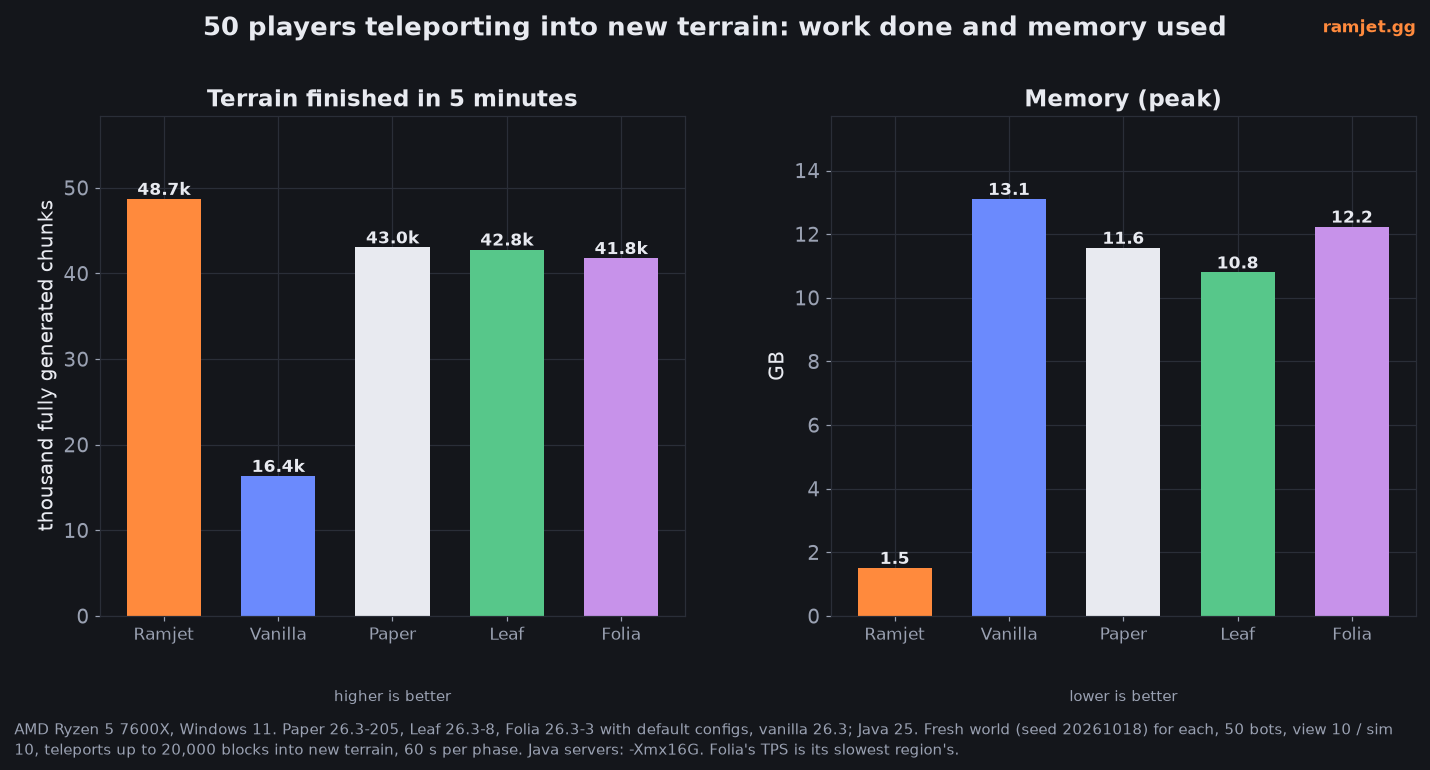
Fifty players teleporting into new terrain
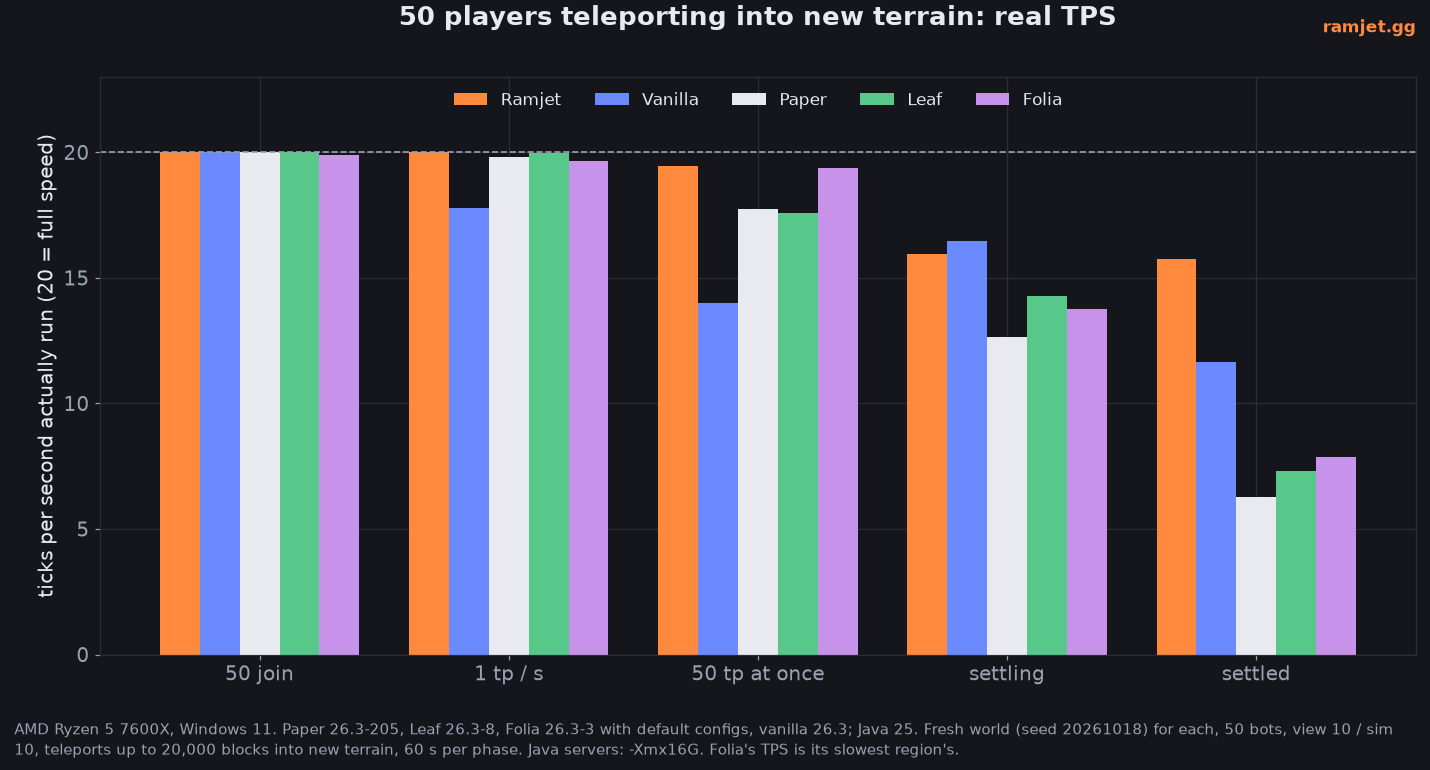
What a busy server with /rtp looks like. Each server starts a fresh world; 50 players join, then get teleported up to 20,000 blocks away into terrain that has never been generated. Each phase lasts 60 seconds: all 50 join; one player per second is sent somewhere new; all 50 are teleported within one second; then nobody moves for two minutes while 50 new areas load, generate and tick.
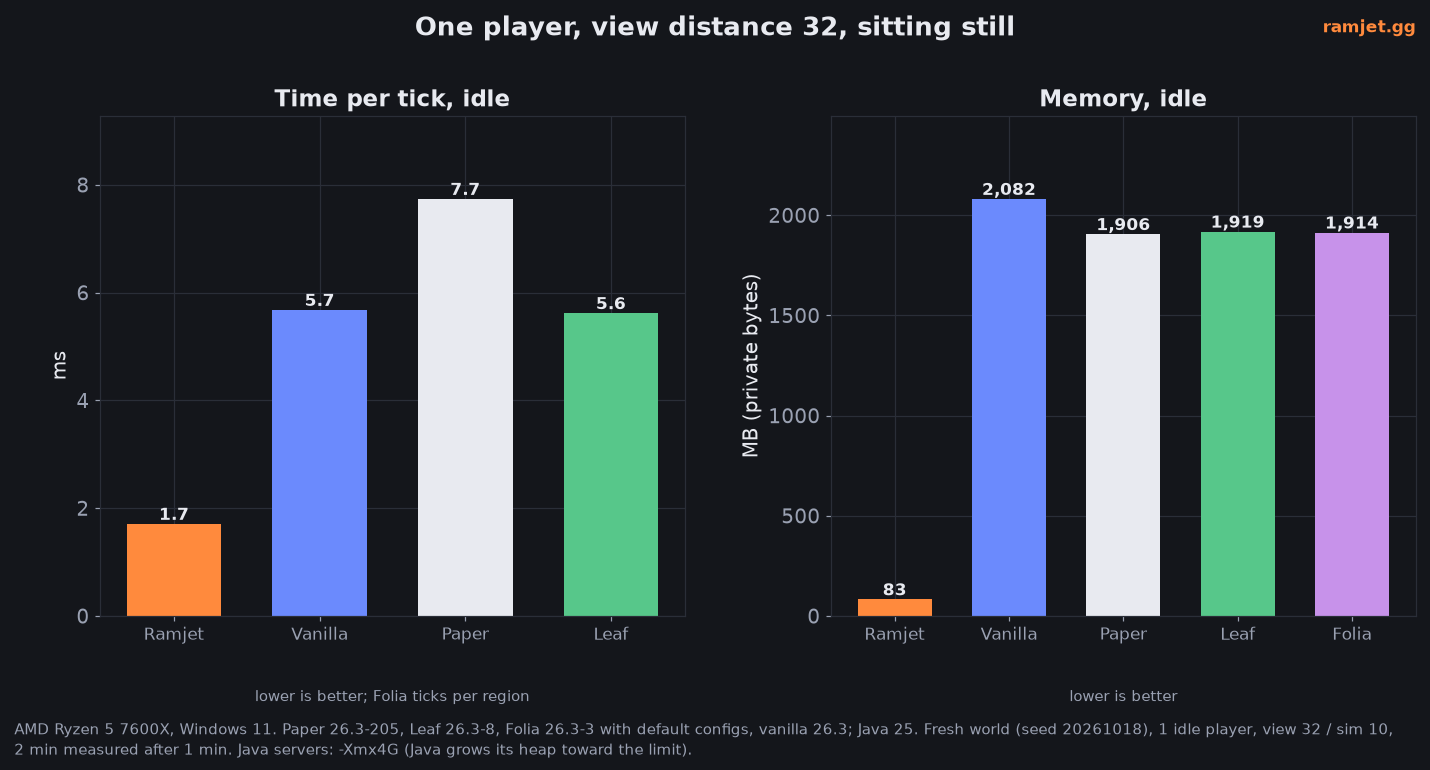
One player, sitting still
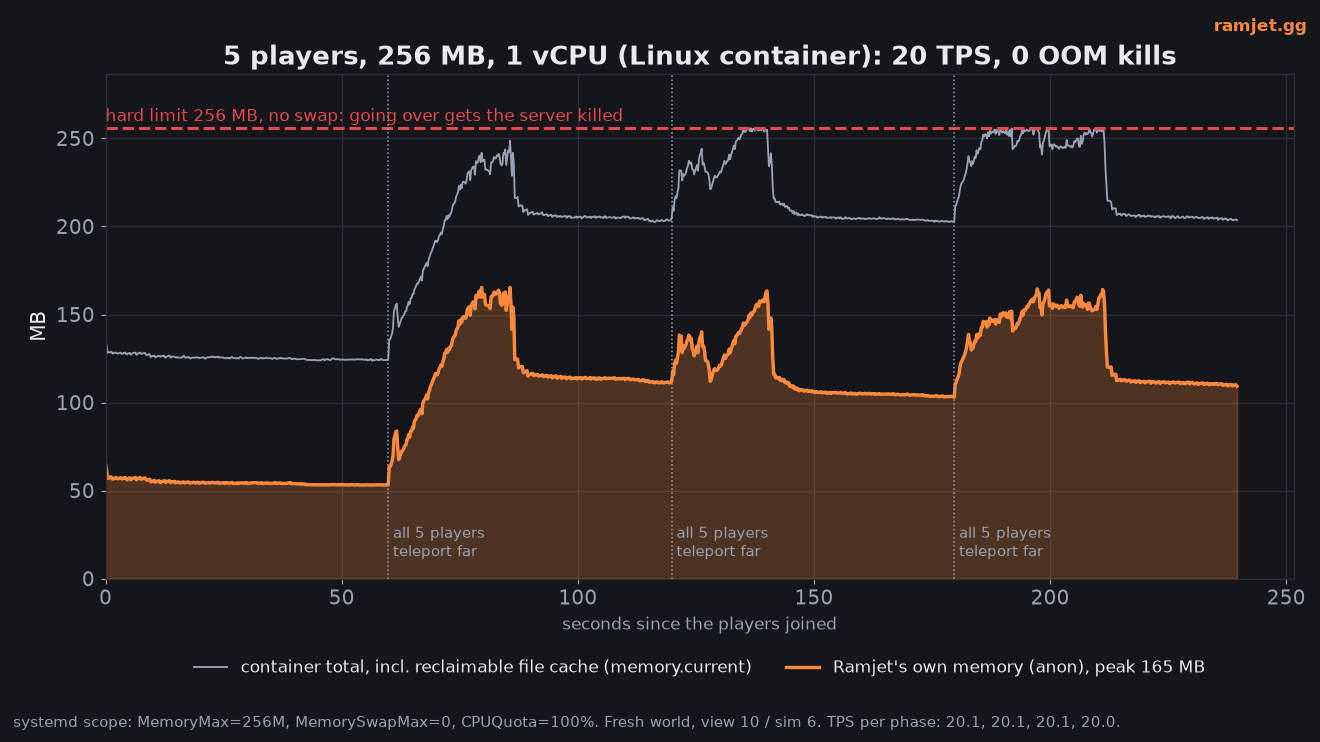
Inside a 256 MB container
Early-access servers get 256 MB and one vCPU, so we tested exactly that on Linux: a hard 256 MB limit, no swap, one CPU's worth of time. Five players join a fresh world, then all five are teleported far away into new terrain three times, a minute apart.
How it was measured
- Machine: AMD Ryzen 5 7600X (6 cores / 12 threads), 96 GB RAM, Windows 11. One server at a time, with nothing else benchmarking or compiling.
- Servers: Ramjet commit
96358329with default settings. Vanilla 26.3.paper-26.3-205,leaf-26.3-8(an early development build, per its authors) andfolia-26.3-3(alpha), downloaded from PaperMC's API and Leaf's GitHub release with their published SHA-256 checksums verified, run with their default configs. Java 25.0.4 with only-Xmxset: 16 GB for the 50-player tests, 4 GB for the idle test. - Worlds: seed
20261018, difficulty easy, no datapacks. View distance 10 and simulation distance 10 for the 50-player tests, view 32 for the idle test. - Players: bots from our load generator that speak the full 26.3 protocol, accept every chunk, keep their view distance and stand still, moved with the console
tpcommand to the same seeded coordinates on every server. - Tick time: each server's own
tick queryevery 5 seconds, averaged over the phase. Folia has notick query; we used itstpsregion report every 5 seconds. - Real TPS:
time query gametimeat the start and end of each phase, ticks actually run divided by wall-clock seconds. For Folia, its slowest region's TPS. - Memory and CPU: read from outside the server once a second through the Windows API (private bytes, process CPU time). On Linux, the container's own cgroup counters.
Questions a fair reader will ask
"You didn't tune Paper."
Right: every server ran its defaults, the way it downloads. Paper, Leaf and Folia can be tuned (entity activation ranges, spawn limits, view distances), and tuning would change their numbers, mostly by simulating less. Ramjet's goal is vanilla behaviour at this speed without turning anything down.
"Folia is built for exactly this."
It is: 50 spread-out players is Folia's best case, and in the equal-work test it held its slowest region at 20 TPS. It used 11.8 GB to do it, with its threads 89 to 91% busy, and with real spawning it dropped to 9.4 TPS at 99.8%.
"Bots aren't real players."
They don't build or fight, so these tests lean on world loading, chunk sending, mob AI, spawning and terrain ticking. They take the same network path as a real client and cost every server the same.
"Can I check this myself?"
Every Ramjet server has /profiler with per-tick timings and supports the same tick query used here. Early-access servers are free: join the queue and try to break it.
Not affiliated with Mojang, Microsoft, PaperMC or the Leaf project.
Try to break it.
Early-access servers are free. Join the queue and we'll email you when you're through.